
Explore inhalation API reformulation, low-GWP propellants, and particle engineering challenges driving sustainable respiratory drug development. Includes market growth insights and regulatory trends shaping next-gen inhalation therapies.
Introduction:
The respiratory drug delivery field is undergoing a significant transformation as pharmaceutical companies seek to reduce the environmental impact of inhalation therapies. Metered-dose inhalers (MDIs), widely used for asthma and chronic obstructive pulmonary disease (COPD), rely on hydrofluoroalkane (HFA) propellants that contribute substantially to greenhouse gas emissions. A recent study published in JAMA estimated that inhalers generated approximately 24.9 million metric tons of carbon dioxide equivalent emissions in the United States between 2014 and 2024, with 98% of these emissions attributed to MDIs.
The industry is now actively transitioning to next-generation low-GWP propellants, principally HFA 152a and HFO 1234ze(E). But replacing a propellant is not a simple ingredient swap. It demands a thorough understanding of the new propellant’s physicochemical properties and how those properties interact with the API, the device, and ultimately lung deposition.
Respiratory API Market Growth Accelerates Demand for Inhalation Innovation
The global respiratory API market is experiencing strong growth, driven by the increasing prevalence of asthma, chronic obstructive pulmonary disease (COPD), allergies, and other respiratory disorders. Recent market analyses estimate that the respiratory API market will grow from USD 20.8 billion in 2025 to nearly USD 39.9 billion by 2035, representing a CAGR of 6.7%. Inhalation-based formulations are expected to be among the fastest-growing segments due to their ability to deliver targeted therapy directly to the lungs while minimising systemic exposure.
The propellant transition is accelerating investment in inhalation development capabilities. For developers, reformulation is no longer solely a sustainability exercise; it is an opportunity to reposition existing products and build pipeline assets in a market that rewards technical differentiation. Advanced particle engineering, formulation optimisation, and analytical characterisation are increasingly the capabilities that determine competitive advantage.
Why Inhalation API Reformulation Is Challenging
Inhalation products are among the most technically demanding drug delivery systems, and reformulation compounds that complexity considerably. The challenge is not simply swapping one propellant for another; it requires rebuilding an understanding of particle behaviour, aerosol mechanics, and lung deposition from the ground up with the new system.
Central to this is maintaining aerodynamic particle size in the 1–5 micron range. Particles outside this window either deposit in the oropharynx or are exhaled before reaching the target airways. Any shift in particle size distribution, however subtle, has direct consequences for therapeutic performance.
New propellants bring different vapour pressures, densities, and solvation characteristics. HFA 152a, for instance, has a higher vapour pressure than HFA 134a, which affects atomisation and plume behaviour. HFO 1234ze(E) presents different co-solvent compatibility profiles. These differences ripple through every aspect of formulation design.
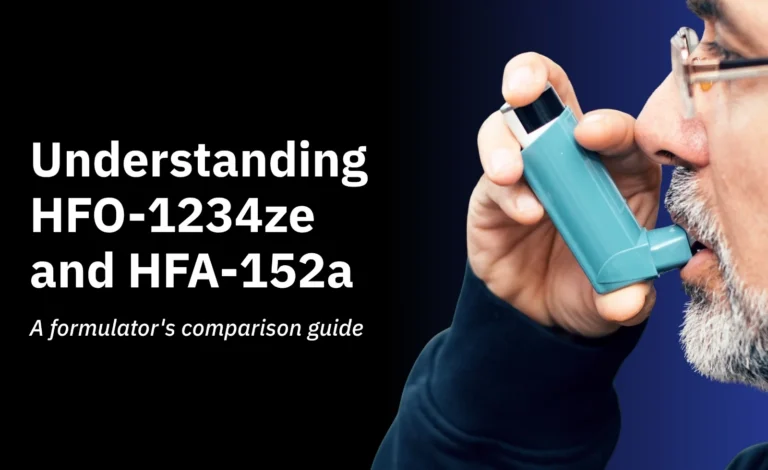
Want to understand how HFO-1234ze and HFA-152a compare for next-generation pMDI reformulation? Read our formulator’s guide here.
Scientific Challenges in Reformulation
Reformulating inhalation APIs requires deep expertise in physicochemical characterisation and aerosol engineering. Key challenges include:
1. Propellant–API Compatibility
New propellants alter solubility dynamics and suspension behaviour. APIs that were physically stable in HFA 134a suspensions may aggregate, settle, or interact differently with excipients in the new system. Surfactant selection and concentration typically need to be revisited entirely.
2. Aerosol Performance Control
Changes in propellant systems directly impact:
- Plume geometry
- Spray pattern
- Droplet size distribution
- Lung deposition efficiency
3. Particle Engineering Requirements
APIs must maintain optimal aerodynamic properties within 1–5 microns despite formulation changes.
4. Stability and Shelf-Life
Suspension stability and dose uniformity throughout the product life must be demonstrated under ICH storage conditions. Reformulated products can exhibit different settling kinetics and resuspension behaviour, which directly affect the consistency of the delivered dose, a critical quality attribute for inhaled products.
Regulatory Expectations (FDA & EMA)
Regulatory agencies require that any reformulated inhalation product demonstrate:
- Equivalent safety and efficacy compared to the original product
- Robust aerosol performance data
- Comprehensive stability studies
- Device–formulation compatibility validation
Because inhalation products are drug-device combination systems, regulatory scrutiny is significantly higher than for conventional dosage forms. Both the FDA and EMA have published detailed guidance on quality and equivalence requirements for reformulated inhalers, and early engagement with these frameworks is strongly advisable.
Partnering for Success
The transition to low-GWP propellants is creating significant demand for inhalation development expertise that many companies lack in-house. Partnering with a specialist CRO with hands-on experience of MDI reformulation, including analytical characterisation, formulation development, and regulatory strategy, substantially reduces development risk and timeline.
At i2c, we have built our capabilities specifically around the complexity of inhalation product development. From early-stage formulation work through to clinical manufacture, we support companies navigating the technical and regulatory demands of MDI reformulation with a team that understands inhaled drug delivery in depth.
Need support with low-GWP MDI reformulation? Partner with i2c.
Conclusion
Inhalation MDI reformulation sits at the intersection of scientific complexity, environmental urgency, and commercial opportunity. The transition away from high-GWP propellants is no longer a future consideration; it is underway, and the development timelines involved mean companies need to be acting now. Those who build the right technical foundation early, whether in-house or through specialist partnerships, will be best placed to bring compliant, high-performing products to a growing respiratory market.
References
- Feldman, W. B. et al. (2025). JAMA: Inhaler-Related Greenhouse Gas Emissions in the US. https://jamanetwork.com/journals/jama/fullarticle/2839471
- JAMA Respiratory Emissions Study. https://jamanetwork.com
- Towards Healthcare (2025). Respiratory API Market Sizing Report. https://www.towardshealthcare.com/insights/respiratory-api-market-sizing
- ResearchGate. Fate of Inhaled API. https://www.researchgate.net
- MarketsandMarkets. API Market Report. https://www.marketsandmarkets.com
- INKE Respiratory Focus. https://www.inke.es/respiratory-focus